

Home > International news > ISO 9001 version 2026 – A universal standard evolving in response to global challenges

ISO 9001 version 2026 - A universal standard evolving to meet global challenges

Facebook
Email
Twitter
LinkedIn
Agri-food expertise

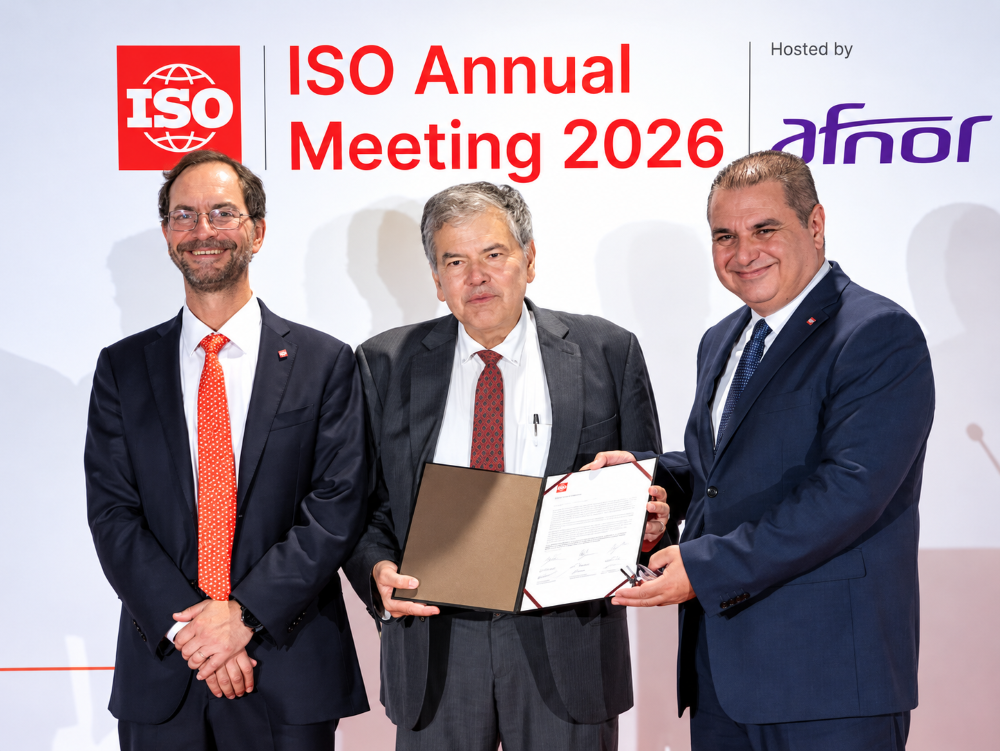
From August 27 to October 14, 2025, theInternational Organization for Standardization (ISO) is inviting public comments on the next edition of ISO 9001, a global pillar of quality management. Millions of certified organizations worldwide are encouraged to participate in the development of this text, which will influence quality management for the next ten years.

🔄 Why a review now?

The previous version of ISO 9001 dates back to 2015. Since then, the economic and social landscape has changed considerably:

  • Digital transformation: data deluge, cybersecurity issues, emergence of artificial intelligence.
  • New customer expectations: development of e-commerce, use of social networks, omnichannel customer experience.
  • Sustainability and climate: greater integration of environmental issues into corporate strategy.
  • Resilience: health crises, supply chain interruptions, geopolitical tensions.

In this context, the standard is currently being revised, with publication scheduled for October 2026.

📝 Major changes planned

According to the preliminary studies and the orientations of the ISO/TC 176 technical committee, several significant changes are expected:

  • Distinct risks and opportunities: improving strategic planning (chapter 6).
  • Climate considerations: climate considerations, already initiated by amendment A1 of 2024, will be further strengthened.
  • A culture of quality and ethics: a focus on governance, transparency and social responsibility.
  • Customer experience: better integration of customer satisfaction and loyalty in performance evaluation (chapter 9).
  • Emerging technologies: consideration of the effects of AI, automation and digitization on quality processes.
  • Organizational resilience: the need to identify and anticipate disruptions that could affect business continuity.

These changes are part of a gradual adaptation process, while preserving the fundamental principles of the standard: purpose, scope, PDCA cycle and risk-based approach.

🌍 What are the challenges for companies that are already certified?

For entities that are already ISO 9001 certified, the revision presents both a challenge and an opportunity:

  • Anticipating new requirements: integrating the climate dimension, ethics and resilience into their quality systems now.
  • Improved global competitiveness: up-to-date certification will be an advantage in international markets, particularly in the face of increasing customer demands.
  • Facilitation for SMEs: the forthcoming version aims to make the standard more accessible, with clarified documents.
  • Harmonization with other standards: greater compatibility with ISO 14001 (environment) and ISO 45001 (health and safety), facilitating an integrated approach.
  • Team mobilization: the review emphasizes management commitment and a shared culture of quality.

📅 Next steps

Each country, via its national standards body, will collect feedback from stakeholders and pass it on to ISO. This is a valuable opportunity for companies, certifiers and experts to influence the world's most widely used standard.

✅ Summary

The revision of ISO 9001 is not a revolution, but a strategic update that responds to contemporary realities: climate, digitalization, ethics and resilience. For companies already certified, getting ready today means turning a constraint into a sustainable competitive advantage.

Read more :
latest news
from the international network

Agri-food expertise
Taiwan 50001
Taiwan

Fengyi Electronics and Jingfeng Electronics Pass ISO 50001 Energy Management System Certification

"Fabao International Certification" announced that "Fengyi Electronics Co., Ltd." and its subsidiary "Jinfeng Electronics Co., Ltd." have successfully passed the ISO 50001:2018 international energy management system certification and obtained the certificate. This certification confirms that both companies have met international standard requirements in the establishment, implementation, and maintenance of their energy management systems. FAB International Certification is an internationally recognized third-party certification body. This certification was conducted in accordance with the ISO 50001 standard and involved a comprehensive assessment of the energy baseline establishment, performance indicators, management plans, and internal audit systems of Fengyi Electronics and Jingfeng Electronics. The certification process confirmed that the group has institutionalized its energy management system, which operates effectively and demonstrates a commitment to continuous improvement. To strengthen energy governance, Fengyi Electronics Group effectively monitors and analyzes energy usage through cross-company resource integration and its own energy monitoring and management system. The simultaneous completion of this certification demonstrates the electronics industry's concrete actions in systematically managing energy efficiency and implementing energy conservation and carbon reduction. FAB International Certification points out that ISO 50001 energy management system certification helps companies systematically improve energy efficiency. Fengyi Electronics Group's certification demonstrates the ability of Taiwanese companies to meet international standards in the areas of sustainable development and energy management. SGS International Certification has long provided various management system certification services to help enterprises strengthen their operational efficiency and environmental performance. In the future, it will continue to promote the implementation of sustainable goals in Taiwan's industries through professional certification.  

Read more "
Taiwan

Taiyo Technology has obtained AS9100 and ISO 27001 management system certifications through international standard certification.

"FAB International Certification" recently announced that Taiyo Technology Co., Ltd. has successfully passed the international certification for the AS9100:2016 aerospace quality management system and the ISO/IEC 27001:2022 information security management system. These two certifications confirm that the company's management systems meet international standards in the fields of aerospace quality control and information security protection. "FAB International Certification" recently announced that "Taiyo Technology Co., Ltd." has successfully passed the international certification of AS9100:2016 Aerospace Quality Management System and ISO/IEC 27001:2022 Information Security Management System. These two certifications confirm that the company's management systems in the fields of aerospace quality control and information security protection meet international standard requirements. As a third-party certification body, "FAB International Certification" conducted a comprehensive assessment of Taiyo Technology's quality management processes, product reliability control, information asset protection, and risk management mechanisms based on the AS9100 and ISO/IEC 27001 standards. The certification results show that the company has established a complete and effective integrated management system, demonstrating its commitment to quality and information security in the high-end manufacturing field. Taiyo Technology is a professional copper foil substrate manufacturer whose products are used in communications, servers, automotive electronics, and other fields. Building on its existing multiple management systems, the company's successful AS9100 and ISO 27001 certification demonstrates its continuous pursuit of excellence and strengthens its professional capabilities as a qualified supplier in the aerospace and defense supply chain. FAB International Certification pointed out that the company's simultaneous AS9100 and ISO 27001 certification demonstrates that its management system can meet the aerospace industry's stringent quality requirements and its high emphasis on supply chain information security. Taiyo Technology's establishment of an international standard management system showcases the competitiveness of Taiwan's manufacturing industry in the high-end market. "FAB International Certification" has long provided certification services in professional fields such as aerospace and information security, assisting enterprises in aligning with international industry standards. In the future, it will continue to promote the upgrading of Taiwan's industry and its integration into the international market through rigorous certification procedures.  

Read more "
Taiwan

Taiwan Railways Administration obtains carbon footprint label for passenger transport through international certification, marking a new milestone in green transportation

Driven by the goal of net-zero carbon emissions, Taiwan Railway Administration actively promotes carbon footprint assessment and information disclosure as an important step in sustainable transformation. After review and approval by the Ministry of the Environment, TRA officially obtained the right to use the passenger transport service carbon footprint label, becoming the first traditional railway transport service provider in Taiwan to obtain the carbon footprint label and setting a benchmark for green transport services in Taiwan. The Taiwan Railway Administration (TRA), formerly known as the Taiwan Railway Bureau under the Ministry of Transportation, was established in 1887 and has a history of more than 137 years. On January 1, 2024, it was restructured into the Taiwan Railway Administration.TRC shoulders the core mission of passenger and freight transportation for the entire Taiwan railway system, covering vehicle operation, infrastructure maintenance, station management, and customer service. It also cooperates with the government in continuously promoting railway modernization projects, making it a crucial transportation infrastructure in Taiwan. Faced with the global trend of net-zero emissions by 2050, the entire social environment and industrial development are undergoing structural changes. Driven by net-zero carbon emissions, Taiwan Railways is actively promoting carbon footprint assessment and information disclosure as an important step in sustainable transformation.Through the promotion of the "2025-2026 Carbon Footprint Assessment and Carbon Reduction Plan for Stations and Passenger Transport Vehicles," and with the completion of carbon footprint verification for the "Tze-Chiang," "Chu-Kuang," and"Local/Local Express" train types. After review and approval by the Ministry of the Environment, Taiwan Railways officially obtained the right to use the passenger transport service carbon footprint label, becoming the first traditional railway transport service operator in Taiwan to obtain the carbon footprint label and setting a benchmark for green transport services in Taiwan. At the carbon footprint label disclosure ceremony, the head of operations for the Asia-Pacific region of Bureau Veritas,During this process, AFNOR Certification followed international standards to conduct carbon footprint audits and data verification for TRA's Tze-Chiang, Ju-Guang, and local/express passenger transport services to ensure data accuracy and compliance. According to the audit results,the Tze-Chiang Express generates 36 grams of carbon dioxide equivalent (CO2e) per passenger-kilometer, the Chu-Kuang Express generates 50 grams of CO2e, and the Local/Local Express trains generate 55 grams of CO2e. Taiwan Railways Administration stated that it will continue to promote system-wide carbon management based on this verification data and combine it with measures such as vehicle replacement, energy efficiency improvements, and smart railways to move towards the goal of net-zero carbon emissions by 2050.The successful collaboration between Taiwan Railway and FSC not only demonstrates Taiwan Railway's firm commitment to sustainable operations, but also highlights FSC's professional capabilities in the field of carbon management verification. Both parties will continue to work together to realize the vision of a low-carbon society and sustainable development in Taiwan.

Read more "
Back to top