Taiwan Railways Administration obtains carbon footprint label for passenger transport through international certification, marking a new milestone in green transportation

Facebook
Email
Twitter
LinkedIn
Agri-food expertise

Driven by the goal of net-zero carbon emissions, Taiwan Railway Administration actively promotes carbon footprint assessment and information disclosure as an important step in sustainable transformation. After review and approval by the Ministry of the Environment, TRA officially obtained the right to use the passenger transport service carbon footprint label, becoming the first traditional railway transport service operator in Taiwan to obtain the carbon footprint label and setting a benchmark for green transport services in Taiwan.
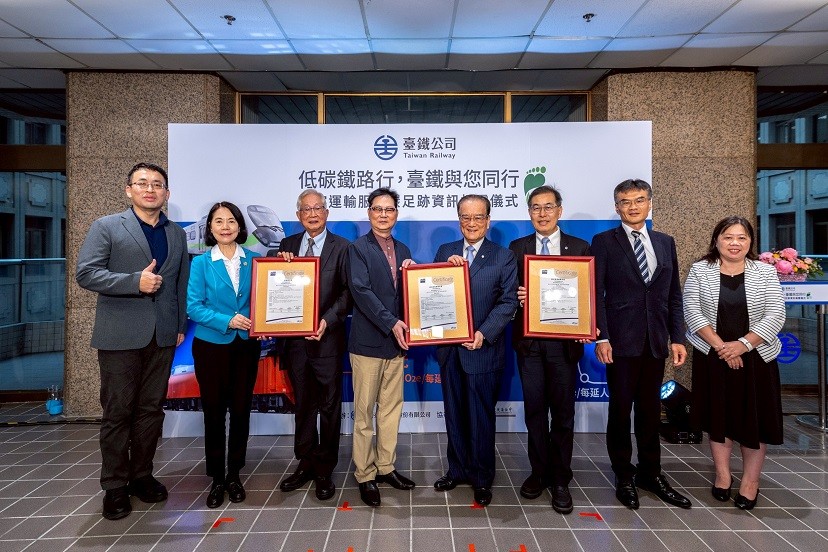
Taiwan Railway Co., Ltd. (TRC), formerly known as the Taiwan Railway Administration under the Ministry of Transportation, was established in 1887 and has a history spanning over 137 years. On January 1, 2024, it was restructured into Taiwan Railway Co., Ltd.Taiwan Railway Co. shoulders the core mission of passenger and freight transportation for the entire Taiwan railway system, covering vehicle operation, infrastructure maintenance, station management, and customer service. It also cooperates with the government in continuously promoting railway modernization projects, making it a crucial transportation infrastructure in Taiwan.

Faced with the global trend toward net-zero emissions by 2050, the entire social environment and industrial development are undergoing structural changes. Driven by net-zero carbon emissions, Taiwan Railways Administration (TRA) is actively promoting carbon footprint assessment and information disclosure as an important step in sustainable transformation.Through the promotion of the "2025-2026 Carbon Footprint Assessment and Carbon Reduction Plan for Stations and Passenger Transport Vehicles," and with the completion of carbon footprint verification for the "Tze-Chiang," "Chu-Kuang," and"Local/Local Express" train types. After review and approval by the Ministry of the Environment, Taiwan Railways officially obtained the right to use the passenger transport service carbon footprint label, becoming the first traditional railway transport service operator in Taiwan to obtain the carbon footprint label and setting a benchmark for green transport services in Taiwan.

At the carbon footprint label unveiling ceremony,During this promotion process, AFNOR Certification followed international standards to conduct carbon footprint audits and data verification for Taiwan Railways' Tze-Chiang, Chu-Kuang, and local/local express passenger transport services to ensure data accuracy and compliance. According to the audit results,the Tze-Chiang Express generates 36 grams of carbon dioxide equivalent (CO2e) per passenger-kilometer, the Chu-Kuang Express generates 50 grams of CO2e, and the local/local express trains generate 55 grams of CO2e.

Taiwan Railway Administration stated that it will continue to promote system-wide carbon management based on this verification data, and will work towards the goal of net-zero carbon emissions by 2050 through measures such as vehicle replacement, energy efficiency improvements, and smart railways.The successful collaboration between Taiwan Railways and FSC not only demonstrates Taiwan Railways' firm commitment to sustainable operations, but also highlights FSC's professional capabilities in the field of carbon management verification. Both parties will continue to work together to realize the vision of a low-carbon society and sustainable development in Taiwan.


latest news
from the international network

Agri-food expertise
Taiwan

Taiwan Railways Administration obtains carbon footprint label for passenger transport through international certification, marking a new milestone in green transportation

Driven by the goal of net-zero carbon emissions, Taiwan Railway Administration actively promotes carbon footprint assessment and information disclosure as an important step in sustainable transformation. After review and approval by the Ministry of the Environment, TRA officially obtained the right to use the passenger transport service carbon footprint label, becoming the first traditional railway transport service provider in Taiwan to obtain the carbon footprint label and setting a benchmark for green transport services in Taiwan. The Taiwan Railway Administration (TRA), formerly known as the Taiwan Railway Bureau under the Ministry of Transportation, was established in 1887 and has a history of more than 137 years. On January 1, 2024, it was restructured into the Taiwan Railway Administration.TRC shoulders the core mission of passenger and freight transportation for the entire Taiwan railway system, covering vehicle operation, infrastructure maintenance, station management, and customer service. It also cooperates with the government in continuously promoting railway modernization projects, making it a crucial transportation infrastructure in Taiwan. Faced with the global trend of net-zero emissions by 2050, the entire social environment and industrial development are undergoing structural changes. Driven by net-zero carbon emissions, Taiwan Railways is actively promoting carbon footprint assessment and information disclosure as an important step in sustainable transformation.Through the promotion of the "2025-2026 Carbon Footprint Assessment and Carbon Reduction Plan for Stations and Passenger Transport Vehicles," and with the completion of carbon footprint verification for the "Tze-Chiang," "Chu-Kuang," and"Local/Local Express" train types. After review and approval by the Ministry of the Environment, Taiwan Railways officially obtained the right to use the passenger transport service carbon footprint label, becoming the first traditional railway transport service operator in Taiwan to obtain the carbon footprint label and setting a benchmark for green transport services in Taiwan. At the carbon footprint label disclosure ceremony, the head of operations for the Asia-Pacific region of Bureau Veritas,During this process, AFNOR Certification followed international standards to conduct carbon footprint audits and data verification for TRA's Tze-Chiang, Ju-Guang, and local/express passenger transport services to ensure data accuracy and compliance. According to the audit results,the Tze-Chiang Express generates 36 grams of carbon dioxide equivalent (CO2e) per passenger-kilometer, the Chu-Kuang Express generates 50 grams of CO2e, and the Local/Local Express trains generate 55 grams of CO2e. Taiwan Railways Administration stated that it will continue to promote system-wide carbon management based on this verification data and combine it with measures such as vehicle replacement, energy efficiency improvements, and smart railways to move towards the goal of net-zero carbon emissions by 2050.The successful collaboration between Taiwan Railway and FSC not only demonstrates Taiwan Railway's firm commitment to sustainable operations, but also highlights FSC's professional capabilities in the field of carbon management verification. Both parties will continue to work together to realize the vision of a low-carbon society and sustainable development in Taiwan.
Read more "
International Globe Australia
International news

AFNOR International establishes presence in Australia and strengthens its global expertise in food safety

AFNOR International kicks off 2026 with a major announcement: the integration of the HACCP Group, a leading Australian player in food safety. This acquisition brings our international network to 38 locations and strengthens our presence in a key region: Australia and the Pacific. A strategic acquisition for the AFNOR Group "The teams, products, and

Read more "
Italy

The "low" risk: what changes for businesses

The simplification of controls on economic activities enters a new phase. With Legislative Decree No. 103 of July 12, 2024, the legislator introduced a system for identifying and assessing "low" risk levels, aimed at making the planning of administrative controls more proportionate, effective, and consistent with the risk profile of

Read more "
100 years of AFNOR
International news

2026: AFNOR celebrates 100 years of trust

In 2026, the AFNOR Group will celebrate an exceptional milestone: 100 years of commitment to trust, progress, and sustainable development. A century during which voluntary standards, certification, and training have accompanied economic, technological, and societal transformations in France and internationally. Today, with 37 locations in

Read more "
qse
International news

2026: the year of major QSE developments

International standards for Quality, Environment, and Occupational Health & Safety management will undergo major changes in 2026. Behind these sometimes technical acronyms—ISO 9001, ISO 14001, and ISO 45001—lie essential tools for companies, which structure their organization and their commitment to their

Read more "
Back to top