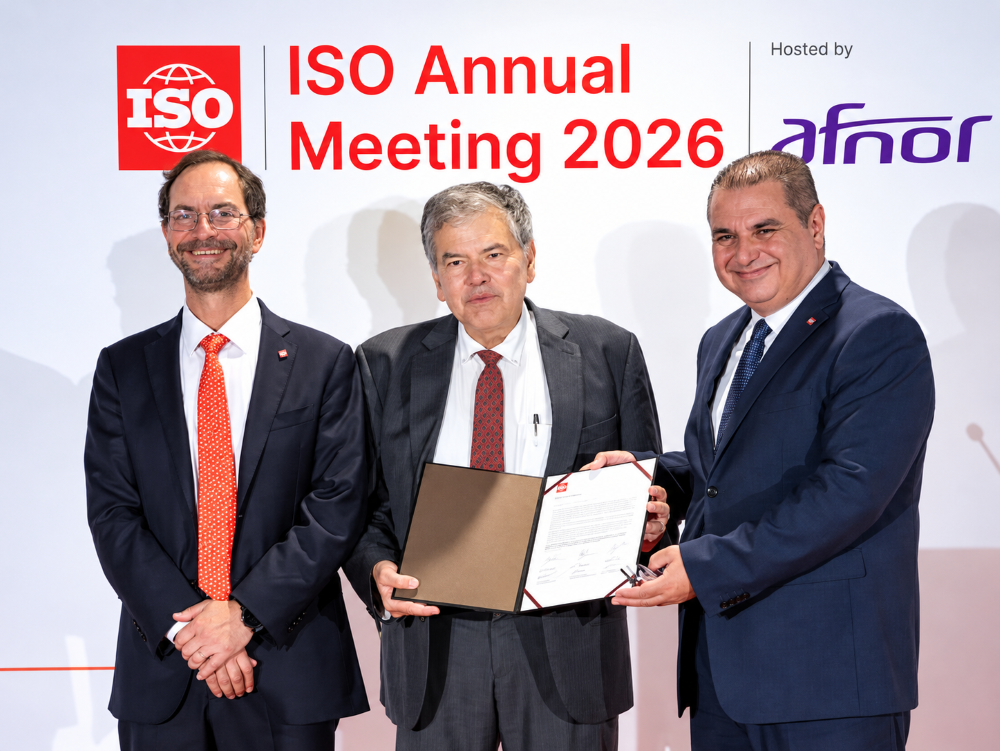
From September 28 to October 2, the 2026 International Organization for Standardization (ISO) Annual General Meeting, hosted by the French Standards Association (AFNOR), was successfully held in Paris, France. As AFNOR celebrated its 100th anniversary, representatives from standardization bodies, policymakers, industry experts, and industry representatives from more than 170 countries and regions around the world gathered in Paris to discuss the key role of international standards in addressing common global challenges. The theme of this year’s conference was “Building Trust in a Changing World.” The agenda centered on three key areas: “People and the Planet,” “Emerging Technologies and Artificial Intelligence,”“Trade and Development.” On the first day of the conference, ISO/UNDP 53001:2026, “United Nations Sustainable Development Goals Management System—Requirements,” was released to help organizations transform the Sustainable Development Goals from commitments into actions that can be managed, implemented, and measured. The conference also hosted a special session on the new ISO 9001 Quality Management System standard, featuring discussions on how quality management can help organizations turn trust into a strategic advantage. This year’s conference heard the ISO Secretary-General’s work report and focused on reviewing major governance matters, including the implementation of “ISO Strategy 2030,” the digital transformation of standards, business policy, the election of governance officers for the 2027–2029 term, and the 2027 financial budget. The winners of the 2026 Lawrence E. Archer Leadership Award were also announced. Throughout its century-long history, AFNOR has consistently been a key participant and driving force in global standardization governance. During the meeting, following a proposal by AFNOR and approval by ISO members, ISO officially released the “Paris Declaration” on addressing climate change in the global standards sector, calling on member countries to rely on international standards to strengthen climate adaptation capacity and development resilience, and to advance the implementation of the global Sustainable Development Goals.