CSR and ISO 26000: findings from an international study on the impact of labels

Facebook
Email
Twitter
LinkedIn
Agri-food expertise

A new study by the Responsibility Europenetwork, of which the AFNOR Group is a member with its Engagé RSE label, confirms what many stakeholders already suspected: organizations with social responsibility labels perform better, both economically and organizationally. This finding is particularly relevant in a context where international regulatory frameworks are converging towards greater transparency and more stringent requirements.

CSR: a driver of performance... everywhere in the world
The question is universal: how can we measure the real impact of a CSR approach? The study conducted in September 2025 by the independent firm Time to Be for Responsibility Europe provides a clear answer, based on an international panel of 743 organizations. The results show that CSR certification is a tangible competitive advantage, regardless of country or sector.

Economic benefits observed internationally

  • 56% of certified organizations report easier access to new markets, including outside their country of origin.
  • 41% report direct financial benefits.
  • 26% have easier access to financing, particularly through bank loans or government programs.

In a context where international investors systematically incorporate ESG criteria, these figures confirm that CSR certification is becoming a global passport.

Beyond economic results, certification acts as an accelerator for organizational transformation. It reinforces the structuring of approaches, clarifies responsibilities, and improves the consistency of actions, particularly in organizations operating on several continents.

An international KPI that confirms the trend: the rise ofISO 26000
To reinforce this observation, an indicator fromthe ISO Survey provides valuable insight. According to the most recent edition, the number of organizations using ISO 26000 as a reference framework has grown by more than 25% in five years, with particularly strong adoption in Europe, Latin America, and Asia-Pacific. Although ISO 26000 does not lead to certification, its global dissemination reflects a clear trend: companies are seeking internationally recognized, structured standards to lend credibility to their CSR initiatives and meet growing market expectations.
This KPI directly supports the conclusions of the Responsibility Europe study: the more the approach is aligned with a robust, international framework, the more it generates performance and transformation.

ISO 26000: a global foundation, an asset in the face of emerging regulations
In a rapidly changing regulatory landscape, ISO 26000 stands out as a universal anchor point. The publication of the updated CSRD directive in Europe, as well as the growing adoption of ISSB standards in many countries, is creating an environment in which organizations must demonstrate the consistency and maturity of their sustainability approach. In this context, ISO 26000 plays a key role. It provides a common language that is understandable and recognized in all regions of the world, enabling multinational companies to harmonize their practices, structure their governance, and facilitate the collection of indicators to meet reporting requirements.

For organizations already certified by a member of the Responsibility Europe network, this methodological consistency translates into greater transparency for international partners and an enhanced ability to anticipate regulatory changes.

As Alain Jounot, President of Responsibility Europe, points out:
"The figures in the study show that committed companies, and even more so those with certification, do not lose competitiveness. On the contrary, they strengthen their position in international markets."

CSR certification is no longer just a marker of commitment: it is a strategic tool for overall performance, recognized and valued internationally. In a world where sustainability requirements are converging, organizations that rely on robust certifications have a clear advantage: credibility, performance, attractiveness, and the ability to transform themselves sustainably.

Read more :
latest news
from the international network

Agri-food expertise
Taiwan 50001
Taiwan

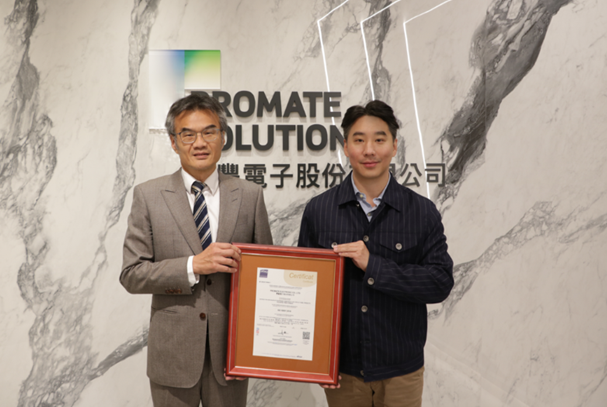
Fengyi Electronics and Jingfeng Electronics Pass ISO 50001 Energy Management System Certification

"Fabao International Certification" announced that "Fengyi Electronics Co., Ltd." and its subsidiary "Jinfeng Electronics Co., Ltd." have successfully passed the ISO 50001:2018 international energy management system certification and obtained the certificate. This certification confirms that both companies have met international standard requirements in the establishment, implementation, and maintenance of their energy management systems. FAB International Certification is an internationally recognized third-party certification body. This certification was conducted in accordance with the ISO 50001 standard and involved a comprehensive assessment of the energy baseline establishment, performance indicators, management plans, and internal audit systems of Fengyi Electronics and Jingfeng Electronics. The certification process confirmed that the group has institutionalized its energy management system, which operates effectively and demonstrates a commitment to continuous improvement. To strengthen energy governance, Fengyi Electronics Group effectively monitors and analyzes energy usage through cross-company resource integration and its own energy monitoring and management system. The simultaneous completion of this certification demonstrates the electronics industry's concrete actions in systematically managing energy efficiency and implementing energy conservation and carbon reduction. FAB International Certification points out that ISO 50001 energy management system certification helps companies systematically improve energy efficiency. Fengyi Electronics Group's certification demonstrates the ability of Taiwanese companies to meet international standards in the areas of sustainable development and energy management. SGS International Certification has long provided various management system certification services to help enterprises strengthen their operational efficiency and environmental performance. In the future, it will continue to promote the implementation of sustainable goals in Taiwan's industries through professional certification.  

Read more "
Taiwan

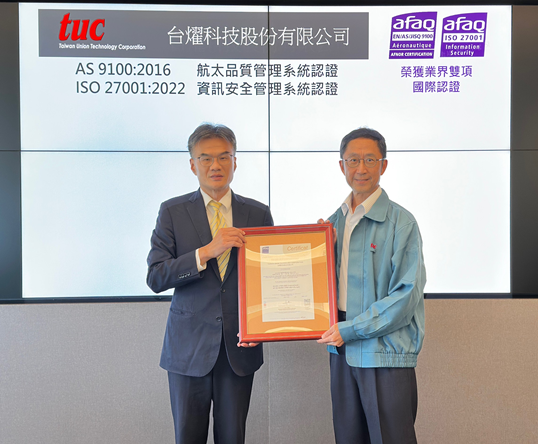
Taiyo Technology has obtained AS9100 and ISO 27001 management system certifications through international standard certification.

"FAB International Certification" recently announced that Taiyo Technology Co., Ltd. has successfully passed the international certification for the AS9100:2016 aerospace quality management system and the ISO/IEC 27001:2022 information security management system. These two certifications confirm that the company's management systems meet international standards in the fields of aerospace quality control and information security protection. "FAB International Certification" recently announced that "Taiyo Technology Co., Ltd." has successfully passed the international certification of AS9100:2016 Aerospace Quality Management System and ISO/IEC 27001:2022 Information Security Management System. These two certifications confirm that the company's management systems in the fields of aerospace quality control and information security protection meet international standard requirements. As a third-party certification body, "FAB International Certification" conducted a comprehensive assessment of Taiyo Technology's quality management processes, product reliability control, information asset protection, and risk management mechanisms based on the AS9100 and ISO/IEC 27001 standards. The certification results show that the company has established a complete and effective integrated management system, demonstrating its commitment to quality and information security in the high-end manufacturing field. Taiyo Technology is a professional copper foil substrate manufacturer whose products are used in communications, servers, automotive electronics, and other fields. Building on its existing multiple management systems, the company's successful AS9100 and ISO 27001 certification demonstrates its continuous pursuit of excellence and strengthens its professional capabilities as a qualified supplier in the aerospace and defense supply chain. FAB International Certification pointed out that the company's simultaneous AS9100 and ISO 27001 certification demonstrates that its management system can meet the aerospace industry's stringent quality requirements and its high emphasis on supply chain information security. Taiyo Technology's establishment of an international standard management system showcases the competitiveness of Taiwan's manufacturing industry in the high-end market. "FAB International Certification" has long provided certification services in professional fields such as aerospace and information security, assisting enterprises in aligning with international industry standards. In the future, it will continue to promote the upgrading of Taiwan's industry and its integration into the international market through rigorous certification procedures.  

Read more "
Taiwan

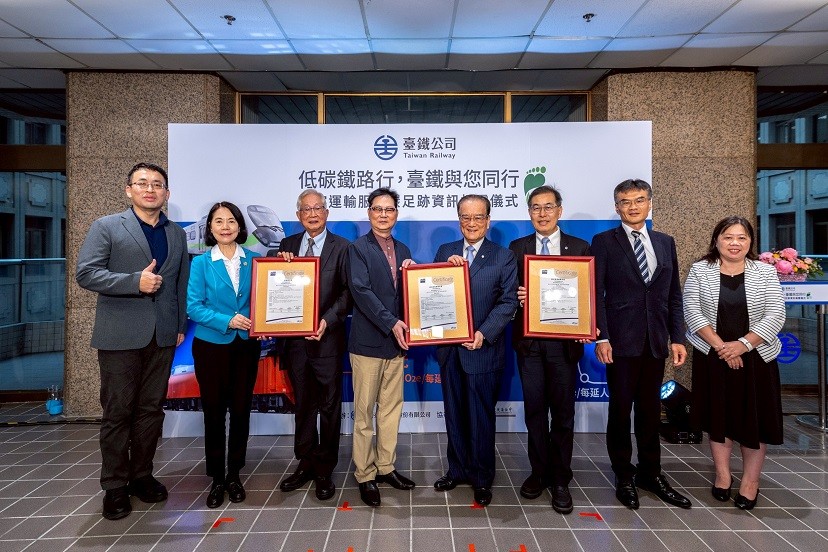
Taiwan Railways Administration obtains carbon footprint label for passenger transport through international certification, marking a new milestone in green transportation

Driven by the goal of net-zero carbon emissions, Taiwan Railway Administration actively promotes carbon footprint assessment and information disclosure as an important step in sustainable transformation. After review and approval by the Ministry of the Environment, TRA officially obtained the right to use the passenger transport service carbon footprint label, becoming the first traditional railway transport service provider in Taiwan to obtain the carbon footprint label and setting a benchmark for green transport services in Taiwan. The Taiwan Railway Administration (TRA), formerly known as the Taiwan Railway Bureau under the Ministry of Transportation, was established in 1887 and has a history of more than 137 years. On January 1, 2024, it was restructured into the Taiwan Railway Administration.TRC shoulders the core mission of passenger and freight transportation for the entire Taiwan railway system, covering vehicle operation, infrastructure maintenance, station management, and customer service. It also cooperates with the government in continuously promoting railway modernization projects, making it a crucial transportation infrastructure in Taiwan. Faced with the global trend of net-zero emissions by 2050, the entire social environment and industrial development are undergoing structural changes. Driven by net-zero carbon emissions, Taiwan Railways is actively promoting carbon footprint assessment and information disclosure as an important step in sustainable transformation.Through the promotion of the "2025-2026 Carbon Footprint Assessment and Carbon Reduction Plan for Stations and Passenger Transport Vehicles," and with the completion of carbon footprint verification for the "Tze-Chiang," "Chu-Kuang," and"Local/Local Express" train types. After review and approval by the Ministry of the Environment, Taiwan Railways officially obtained the right to use the passenger transport service carbon footprint label, becoming the first traditional railway transport service operator in Taiwan to obtain the carbon footprint label and setting a benchmark for green transport services in Taiwan. At the carbon footprint label disclosure ceremony, the head of operations for the Asia-Pacific region of Bureau Veritas,During this process, AFNOR Certification followed international standards to conduct carbon footprint audits and data verification for TRA's Tze-Chiang, Ju-Guang, and local/express passenger transport services to ensure data accuracy and compliance. According to the audit results,the Tze-Chiang Express generates 36 grams of carbon dioxide equivalent (CO2e) per passenger-kilometer, the Chu-Kuang Express generates 50 grams of CO2e, and the Local/Local Express trains generate 55 grams of CO2e. Taiwan Railways Administration stated that it will continue to promote system-wide carbon management based on this verification data and combine it with measures such as vehicle replacement, energy efficiency improvements, and smart railways to move towards the goal of net-zero carbon emissions by 2050.The successful collaboration between Taiwan Railway and FSC not only demonstrates Taiwan Railway's firm commitment to sustainable operations, but also highlights FSC's professional capabilities in the field of carbon management verification. Both parties will continue to work together to realize the vision of a low-carbon society and sustainable development in Taiwan.

Read more "
Back to top