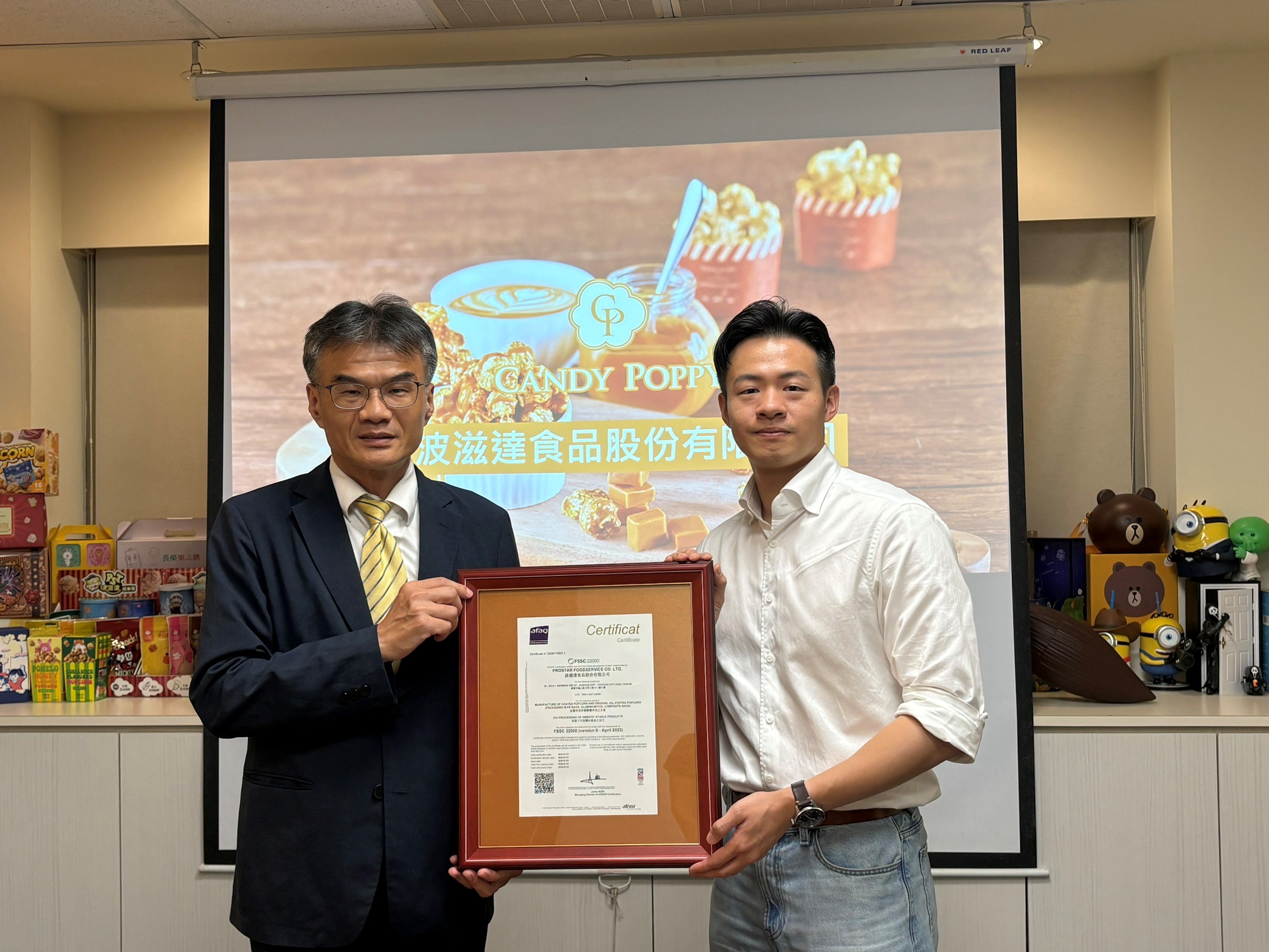


「斌視企業股份有限公司」獲頒ISO 9001 : 2015 系統驗證合格證書

Facebook
Email
Twitter
LinkedIn
Agri-food expertise

1988 年創立于台南的 「斌視企業股份有限公司」, 憑藉著化工專業與多年的鏡片光學研發技術,順利於2023年5月通過「Afnor集團」之ISO 9001 : 2015品質管制系統驗證,成為臺灣抗藍光鏡片專利的製造商中第一家通過品質管制系統驗證的企業。
該企業產品定位於中高價路線,在各式護眼專利鏡片(如抗藍光鏡片與抗紅外線鏡片)上持續研發、製造,更開發出多樣化的鏡片顏色與用途, 提供客戶各式客制化服務,使產品得以進軍歐美、日、韓等國。在技術層面,除引進日本射出機, 同時結合特殊強化加工技術等方式,使鏡片表面耐磨係數高於一般鏡片;更利用精密檢測儀器確保產品品質,創造差異化優勢。
另外,為滿足研發動能,積極運用產學合作資源、參與國內各項產業發展計畫,更與大學合作建立眼睛保健評估機制,並跟隨消費者習慣,建立電商平臺、透過電子行銷管道,拓展東北亞、中東市場,提供海內外客戶與消費者專業的技術與更完善的眼部保護。

latest news
from the international network

Agri-food expertise
Taiwan 50001
Taiwan

Fengyi Electronics and Jingfeng Electronics Pass ISO 50001 Energy Management System Certification

"Fabao International Certification" announced that "Fengyi Electronics Co., Ltd." and its subsidiary "Jinfeng Electronics Co., Ltd." have successfully passed the ISO 50001:2018 international energy management system certification and obtained the certificate. This certification confirms that both companies have met international standard requirements in the establishment, implementation, and maintenance of their energy management systems. FAB International Certification is an internationally recognized third-party certification body. This certification was conducted in accordance with the ISO 50001 standard and involved a comprehensive assessment of the energy baseline establishment, performance indicators, management plans, and internal audit systems of Fengyi Electronics and Jingfeng Electronics. The certification process confirmed that the group has institutionalized its energy management system, which operates effectively and demonstrates a commitment to continuous improvement. To strengthen energy governance, Fengyi Electronics Group effectively monitors and analyzes energy usage through cross-company resource integration and its own energy monitoring and management system. The simultaneous completion of this certification demonstrates the electronics industry's concrete actions in systematically managing energy efficiency and implementing energy conservation and carbon reduction. FAB International Certification points out that ISO 50001 energy management system certification helps companies systematically improve energy efficiency. Fengyi Electronics Group's certification demonstrates the ability of Taiwanese companies to meet international standards in the areas of sustainable development and energy management. SGS International Certification has long provided various management system certification services to help enterprises strengthen their operational efficiency and environmental performance. In the future, it will continue to promote the implementation of sustainable goals in Taiwan's industries through professional certification.  

Read more "
Taiwan

Taiyo Technology has obtained AS9100 and ISO 27001 management system certifications through international standard certification.

"FAB International Certification" recently announced that Taiyo Technology Co., Ltd. has successfully passed the international certification for the AS9100:2016 aerospace quality management system and the ISO/IEC 27001:2022 information security management system. These two certifications confirm that the company's management systems meet international standards in the fields of aerospace quality control and information security protection. "FAB International Certification" recently announced that "Taiyo Technology Co., Ltd." has successfully passed the international certification of AS9100:2016 Aerospace Quality Management System and ISO/IEC 27001:2022 Information Security Management System. These two certifications confirm that the company's management systems in the fields of aerospace quality control and information security protection meet international standard requirements. As a third-party certification body, "FAB International Certification" conducted a comprehensive assessment of Taiyo Technology's quality management processes, product reliability control, information asset protection, and risk management mechanisms based on the AS9100 and ISO/IEC 27001 standards. The certification results show that the company has established a complete and effective integrated management system, demonstrating its commitment to quality and information security in the high-end manufacturing field. Taiyo Technology is a professional copper foil substrate manufacturer whose products are used in communications, servers, automotive electronics, and other fields. Building on its existing multiple management systems, the company's successful AS9100 and ISO 27001 certification demonstrates its continuous pursuit of excellence and strengthens its professional capabilities as a qualified supplier in the aerospace and defense supply chain. FAB International Certification pointed out that the company's simultaneous AS9100 and ISO 27001 certification demonstrates that its management system can meet the aerospace industry's stringent quality requirements and its high emphasis on supply chain information security. Taiyo Technology's establishment of an international standard management system showcases the competitiveness of Taiwan's manufacturing industry in the high-end market. "FAB International Certification" has long provided certification services in professional fields such as aerospace and information security, assisting enterprises in aligning with international industry standards. In the future, it will continue to promote the upgrading of Taiwan's industry and its integration into the international market through rigorous certification procedures.  

Read more "
Taiwan

Taiwan Railways Administration obtains carbon footprint label for passenger transport through international certification, marking a new milestone in green transportation

Driven by the goal of net-zero carbon emissions, Taiwan Railway Administration actively promotes carbon footprint assessment and information disclosure as an important step in sustainable transformation. After review and approval by the Ministry of the Environment, TRA officially obtained the right to use the passenger transport service carbon footprint label, becoming the first traditional railway transport service provider in Taiwan to obtain the carbon footprint label and setting a benchmark for green transport services in Taiwan. The Taiwan Railway Administration (TRA), formerly known as the Taiwan Railway Bureau under the Ministry of Transportation, was established in 1887 and has a history of more than 137 years. On January 1, 2024, it was restructured into the Taiwan Railway Administration.TRC shoulders the core mission of passenger and freight transportation for the entire Taiwan railway system, covering vehicle operation, infrastructure maintenance, station management, and customer service. It also cooperates with the government in continuously promoting railway modernization projects, making it a crucial transportation infrastructure in Taiwan. Faced with the global trend of net-zero emissions by 2050, the entire social environment and industrial development are undergoing structural changes. Driven by net-zero carbon emissions, Taiwan Railways is actively promoting carbon footprint assessment and information disclosure as an important step in sustainable transformation.Through the promotion of the "2025-2026 Carbon Footprint Assessment and Carbon Reduction Plan for Stations and Passenger Transport Vehicles," and with the completion of carbon footprint verification for the "Tze-Chiang," "Chu-Kuang," and"Local/Local Express" train types. After review and approval by the Ministry of the Environment, Taiwan Railways officially obtained the right to use the passenger transport service carbon footprint label, becoming the first traditional railway transport service operator in Taiwan to obtain the carbon footprint label and setting a benchmark for green transport services in Taiwan. At the carbon footprint label disclosure ceremony, the head of operations for the Asia-Pacific region of Bureau Veritas,During this process, AFNOR Certification followed international standards to conduct carbon footprint audits and data verification for TRA's Tze-Chiang, Ju-Guang, and local/express passenger transport services to ensure data accuracy and compliance. According to the audit results,the Tze-Chiang Express generates 36 grams of carbon dioxide equivalent (CO2e) per passenger-kilometer, the Chu-Kuang Express generates 50 grams of CO2e, and the Local/Local Express trains generate 55 grams of CO2e. Taiwan Railways Administration stated that it will continue to promote system-wide carbon management based on this verification data and combine it with measures such as vehicle replacement, energy efficiency improvements, and smart railways to move towards the goal of net-zero carbon emissions by 2050.The successful collaboration between Taiwan Railway and FSC not only demonstrates Taiwan Railway's firm commitment to sustainable operations, but also highlights FSC's professional capabilities in the field of carbon management verification. Both parties will continue to work together to realize the vision of a low-carbon society and sustainable development in Taiwan.

Read more "
Back to top