The certification that recognizes organizations committed to the well-being of individuals and families and to social sustainability.
 WHAT IS THE UNI/PDR 192:2026 STANDARD?
The UNI/PdR 192:2026 standard defines the requirements for establishing a management system dedicated to work-life balance.
It does not merely introduce individual corporate welfare initiatives, but rather proposes a structured organizational model based on governance, measurable objectives, key performance indicators (KPIs), audits, and continuous improvement. It is applicable to public and private organizations in any sector that employ staff.
 WHY GET CERTIFIED?
⭐ Reputation – Demonstrate your commitment to people, customers, and stakeholders.
👥 Employer Branding – Attract and retain talent by prioritizing people’s well-being.
📊 Measurable KPIs – Monitor the effectiveness of policies using verifiable metrics.
🏛 Governance – Integrates work-life balance into decision-making processes.
🌍 ESG – Strengthens the organization’s contribution to social sustainability.
🔄 Integration with UNI/PdR 125 – Leverage synergies with the gender equality management system.
 THE 7 EVALUATION AREAS
UNI/PdR 192:2026 identifies seven areas through which organizations plan, implement, and monitor their work-life balance policies. For each area, specific qualitative and quantitative indicators (KPIs) are provided, which are used to assess the effectiveness of the Management System and compliance with the requirements set forth in the Standard.
- Work Organization and Flexibility
An organization that is truly committed to work-life balance promotes work arrangements that enable people to manage their professional and personal commitments in a balanced way.
This area includes measures such as flexible schedules, agile work, remote work, part-time work, sustainable meeting planning, and access to the organization’s policies, promoting more inclusive and results-oriented work models.
- Maternity Support
Motherhood is one of the most challenging phases of a person's career.
Prassi promotes policies that support female employees before, during, and after maternity leave, ensuring they receive accurate information about leave, maintaining their connection with the organization, and facilitating a return to work that values their professional continuity and the skills they have developed.
- Parenting Support
Parental responsibility involves both parents and requires organizational policies that promote a genuine sharing of family responsibilities.
This section includes initiatives for mothers and fathers, tools to support family management, dedicated services, and measures designed to help balance parenting responsibilities with work throughout one’s career.
- Support for Caregiving Responsibilities
Increased life expectancy and growing caregiving responsibilities are making the role of caregivers increasingly central.
UNI/PdR 192:2026 recognizes organizations that implement measures to support individuals caring for elderly, frail, dependent, or disabled family members, acknowledging the importance of these needs in workplace design.
- Health and Well-Being
People's well-being is an essential element of organizational sustainability.
This area includes initiatives focused on prevention, the protection of physical and mental health, supplemental support services, and the promotion of work environments that foster people’s overall well-being.
- Financial Support and Services for Families
Work-life balance policies can be strengthened through concrete measures to support families.
This area includes financial assistance, vouchers, agreements, “time-saving” services, initiatives for children, and support measures for those who are not self-sufficient, with the goal of reducing the impact of family responsibilities on work life.
- Professional Development and Career Continuity
Work-life balance should not be an obstacle to professional growth.
UNI/PdR 192:2026 promotes development pathways based on the enhancement of skills, equal opportunity, non-discrimination, and the protection of career continuity, even during the various stages of family life and caregiving responsibilities
 WHO IS THE UNI/PDR 192:2026 CERTIFICATION INTENDED FOR?
The UNI/PdR 192:2026 certification is intended for all organizations that wish to adopt a structured approach to work-life balance by integrating such policies into their management system.
The Prassi is applicable to public and private organizations, regardless of their sector of activity, provided they employ staff. Thanks to its process-based approach, the model can be adapted to organizations of various sizes and different operational contexts.
Private Companies
For companies of all sizes that want to promote employee well-being, strengthen their employer brand, and integrate work-life balance into their growth and sustainability strategies.
Public Administrations
For public entities that wish to develop organizational models focused on employee well-being, service efficiency, and the development of human capital.
Third Sector Organizations
For associations, foundations, social cooperatives, and nonprofit organizations that wish to formalize and highlight their commitment to individuals, families, and communities through a recognized management system.
 UNI/PDR 125:2022 and UNI/PDR 192:2026
Two complementary certifications for sustainable human resources management
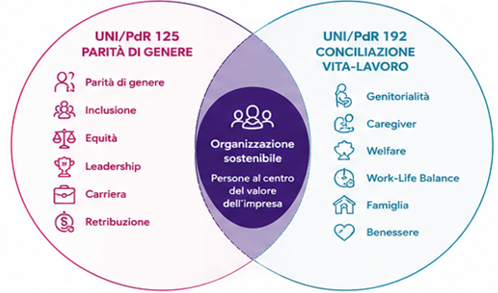
UNI/PdR 125:2022 and UNI/PdR 192:2026 are not alternatives; rather, they address different and complementary aspects of organizational sustainability.
UNI/PdR 125 promotes gender equality and inclusion in business processes. UNI/PdR 192 expands on this approach by introducing a management system dedicated to work-life balance, with a particular focus on parenting, caregivers, organizational flexibility, and the well-being of individuals and families.
UNI/PdR 125:2022
- Gender Equality
- Equity and Inclusion
- HR Governance and Processes
- Pay Equity and Career Development
- Indicators Related to Gender Equality
UNI/PdR 192:2026
- Work-Life Balance
- Parenting and Caregiving Responsibilities
- Work Organization and Flexibility
- Professional Continuity During Treatment Phases
- Indicators related to work-life balance and family well-being
A Natural Integration
For organizations that are already UNI/PdR 125-certified, adopting UNI/PdR 192 may be particularly straightforward. Many elements of the management system—such as governance, documented processes, monitoring, audits, and reviews—can in fact serve as a solid foundation upon which to integrate the specific requirements of the new standard.
However, it was still necessary to demonstrate compliance with the requirements and indicators set forth in UNI/PdR 192:2026.
Integrated Audit
When both certifications are in place, audits can be planned in an integrated manner. This approach allows for the optimization of audit timelines and activities, reducing the organizational impact and promoting more efficient management of the certification process.
 HOW CERTIFICATION WORKS
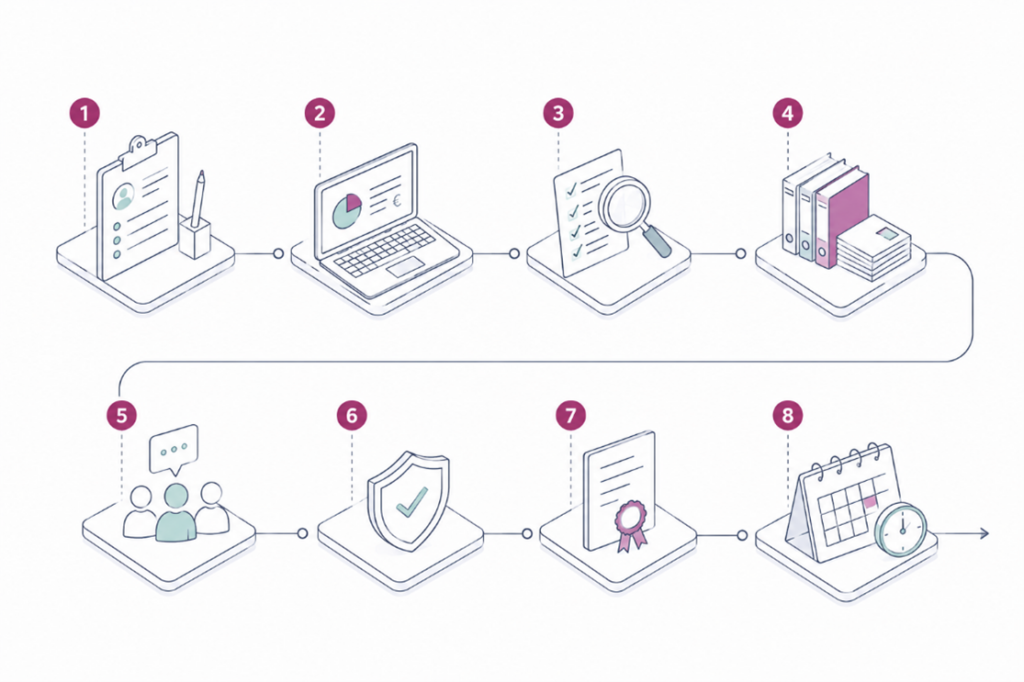
The certification process follows a structured procedure that allows for an independent verification of the Management System’s compliance with the requirements of UNI/PdR 192:2026.
- Information Collection
The organization provides the information needed to define the scope of the certification, the number of employees, the locations involved, and the key organizational characteristics.
- Technical and Financial Proposal
Based on the information gathered, a certification proposal is prepared, outlining the audit procedures, timeline, and planned activities.
- Pre-audit (optional)
At the organization’s request, a preliminary assessment may be conducted to identify any areas that need improvement prior to the certification audit.
- Stage 1 Audit
The auditors review the Management System documentation and assess the organization’s level of preparedness, and they plan the activities for Stage 2.
- Stage 2 Audit
The effective implementation of the Management System is assessed through an analysis of the processes, records, and results achieved.
- Technical Review
The audit findings undergo an independent technical evaluation, which supports the final decision on whether to grant certification.
- Issuance of the certificate
If there are no outstanding nonconformities and following a successful technical review, the certificate of conformity is issued.
- Monitoring and Renewal
Certification is maintained through periodic surveillance audits and subsequent renewal audits, which verify that the management system is being maintained and improved over time.
RESOURCES
- 📄 Download the free fact sheet on UNI/PdR 192:2026: https://mcusercontent.com/790eebc02f162281cd78dce71/files/36819367-c30f-8fe1-9de7-309bd662c986/AFNOR_UNI_PdR_192_2026.pdf
- 🎥 Dedicated webinar: https://forms.gle/L3kvEBs7V2tnD8zN7
Would you like to have your organization certified according to UNI/PdR 192:2026?
Request a quote or consult with our experts.